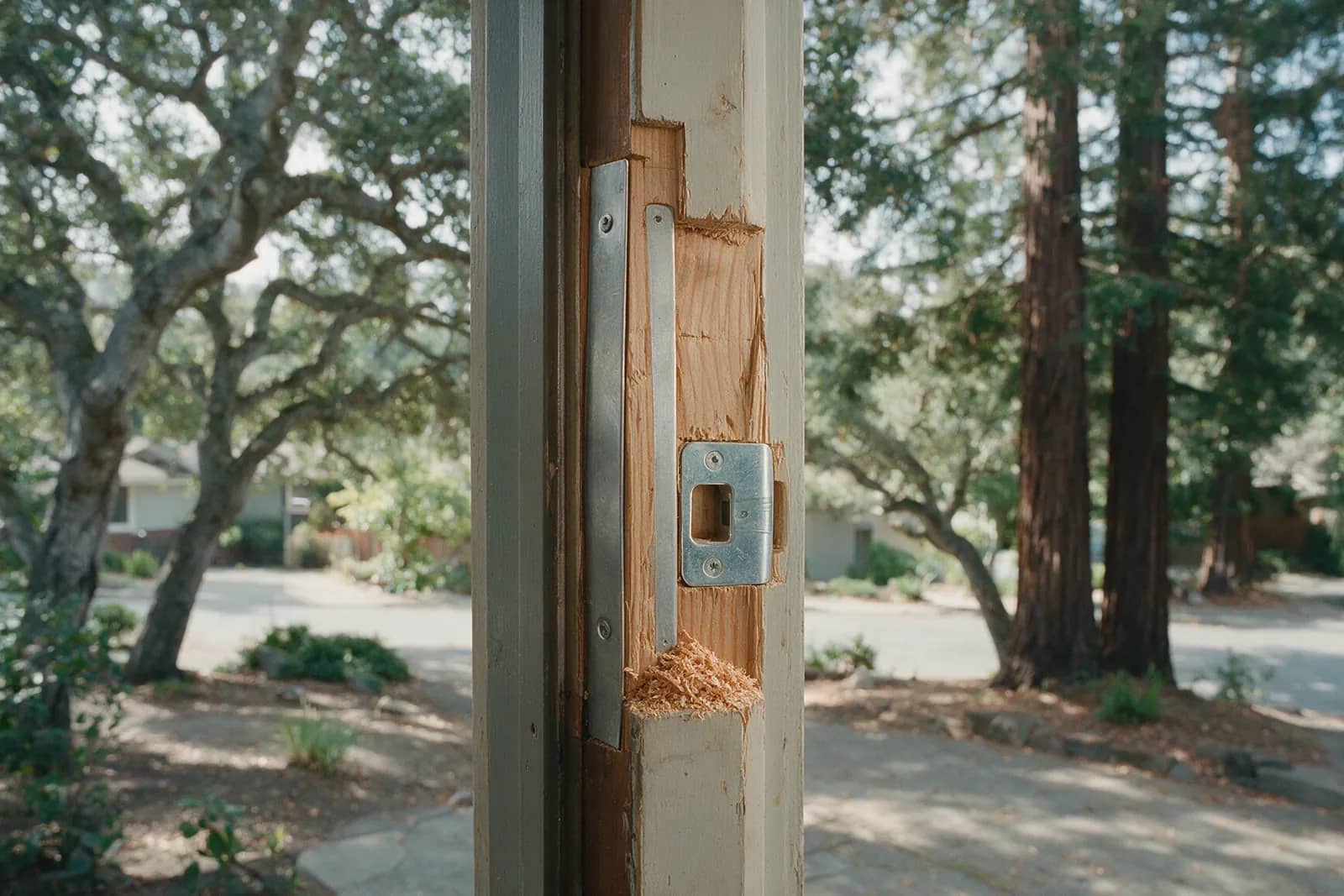
The three locks nobody in the building owns
In a small co-op or a twelve-unit building below campus, every member knows exactly who is responsible for their own unit door and nobody is sure who is responsible for the rest. The street door, the mailbox bank in the entry, the laundry room and the storage cage sit in a gap between the household and the board, and they are the three locks that go years without attention. They are also the ones every resident touches daily.
The useful move is to treat them as one visit rather than three complaints. A technician already on site for the street door can swap a mailbox cam, cut keys for the laundry room and check the storage hasp in the same appointment, with each item on its own line of one agreed figure. The service call is $89 and it sits inside that figure once, not once per lock.
The street door that clicks but does not latch
The entry door of a building like this normally has an electric strike in the jamb, wired to the buzzer panel, and a closer above. When someone presses the button upstairs, the strike releases so the door can be pushed. When it is not being buzzed, the latch is supposed to sit in that strike and hold. What usually goes wrong is mechanical, not electrical: the closer no longer drives the door fully home, or the strike keeper has been pushed out of alignment by years of people shoving the door while it buzzes, so the latch rests on the lip instead of dropping in.
That is a locksmith job. Aligning or replacing a strike, adjusting the closer and setting the keeper is straightforward, and it is what stops the entry standing ajar all afternoon. If the release is not energizing at all, the fault may be the transformer or the wiring, and the honest answer is a note to the board saying which of the two it is, rather than a replacement door sold on a hunch.
The intercom that rings a phone from 2014
Most small buildings now use a telephone entry panel: the directory calls a resident phone number and the resident presses a digit to release the door. The classic Berkeley failure is a directory nobody has edited since two rounds of members ago, so half the buttons ring numbers that belong to strangers and residents get in the habit of leaving the door on the latch for guests. That is a programming task on the panel, done with the installer code, and it is worth pairing with the mechanical work above.
Where the line runs matters too. Panels wired to a copper line that the carrier retired, or to an analog port on equipment nobody maintains, do not become working intercoms again through locksmithing. That is a phone or an intercom vendor call. What a locksmith settles is the door itself, so that at least the entry latches while the board decides what to do about the panel, and what a locksmith will not do is bill a co-op for a diagnosis outside their trade.
Mailbox banks, cam locks and the arrow lock
A mailbox lock in one of these buildings is normally a small cam lock: a cylinder with a flat metal tongue that rotates behind the door edge. Swapping one is a quick job and it is the right response when a member moves out, when a key goes missing, or when the tenant before you was handed the same key by the tenant before them. Old cam locks also simply wear, at which point the tongue no longer holds and the door swings open when the carrier closes the bank.
One boundary is worth knowing. In many buildings the carrier opens the whole bank with a single arrow lock owned by the post office; that lock is theirs and is never touched by a private locksmith. The individual compartment locks belong to the building. If the bank is a newer cluster unit on the sidewalk rather than a wall panel in the lobby, the post office may own more of it, and the first call should be to the local station. For an interior lobby bank in an older building, it is the co-op that decides and the co-op that pays.
Getting a board to approve the work
Small co-op boards do not decline this work; they decline vague requests for it. What passes at a meeting is a list with counts and a figure: entry strike and closer adjustment, four mailbox cams replaced, laundry room cylinder repinned with six keys cut, storage hasp replaced, one total. Campanile Lock & Key will provide that written line before the visit and an itemized receipt by email after it, which is what a treasurer needs to put the payment through.
The terms are the same as for any other call. The figure is agreed on the call and covers the visit, the labour and the parts; the technician name and a thirty-minute window arrive by text before the van leaves; the lock is opened without damage first and drilling only follows your agreement, at the same figure; and payment is card or tap at the door. For a building that shares its costs, having the written line in advance is often the whole difference between a repair happening in April and happening in September.
What the visit typically costs
Repinning cylinders is $22 to $37 each, so a laundry room and a storage room together are a small number. Replacing a worn cylinder or a failed cam is a lock replacement at $105 to $285 depending on the hardware. Where a lobby door or a mailbox bank has been pried and the frame or the door edge is damaged, the repair with a reinforced strike runs $149 to $399. A unit lockout for a member who left keys inside is $109 to $189, with $35 added after 8pm and $70 after midnight.
The pattern that keeps a small building working is one scheduled visit a year for the shared locks, plus a mailbox cam swap whenever a unit changes hands. Both are cheap. The expensive version is the building that waits until the entry door has stood unlatched for three seasons and the mailbox bank has to be replaced instead of rekeyed.
Quick answers
Can a locksmith change my mailbox lock in an apartment building?+
The individual compartment cam locks in an interior lobby bank belong to the building and can be changed, usually with the manager or board aware. The single arrow lock the carrier uses to open the whole bank belongs to the post office and is never touched.
Our buzzer opens the door but it never latches. Is that the intercom?+
Almost always no. It is the closer failing to push the door fully home, or an electric strike keeper knocked out of alignment. Both are mechanical fixes done in a single visit, and they are what stops the entry standing ajar.
Who pays for shared-lock work in a co-op?+
The building, in nearly every case, since the entry, mailbox bank, laundry and storage are common areas. Ask for a written line with the item counts and one figure before the visit, and an itemized receipt afterward, so the treasurer has what the books need.
Need it handled rather than read about?
(510) 392-6966More guides