Why twenty-six minutes is written down
Across Berkeley the average arrival is nineteen minutes. For addresses above Grizzly Peak Blvd and the upper reaches of Euclid Ave, the honest number is twenty-six, and it is published that way rather than quietly averaged into the rest. The reason is geometry. There is no direct route up: the roads climb in switchbacks, most of them are one lane in practice once cars are parked along a side, and the final approach to a specific house often has no place to turn around. A van does the last part slowly whatever the hour.
What the hill does not do is change the money. The service call is $89 at sea level and at fifteen hundred feet. A house lockout is $109 to $189 in the flats and on a ridge. There is no distance surcharge, no hill fee and no figure revised at the top of the stairs after the technician has seen the driveway. The only supplements that exist anywhere on the map are time-based: $35 from 8pm to midnight, $70 from midnight to 7am, stated inside the total when it is agreed.
Where the van can actually stop
The single most useful thing a hill caller can say is where a vehicle can legally and physically stand near the address. Some of these streets have parking on the downhill side only, some have a red-painted curb the whole length because of the turning radius, and a few finish at a fire road gate rather than a cul-de-sac. If your own driveway is short and steep, say whether a van can nose in without grounding, because plenty cannot.
It matters because everything the technician needs is carried from that spot: a case of cylinders, pinning kit and key blanks, plus a drill and a bit set that will hopefully stay in the van. Two flights of steps with a case is fine when it is expected and awkward when it is discovered. On the rare address where the house is a hundred yards down a footpath from the road, mention it, and the visit is planned around it instead of around a guess.
The gate at the sidewalk
A great many hill properties have a gate at the street, and it is the first lock of the visit whether or not anybody thought of it as one. Three arrangements are common: a keypad, an intercom to the house, or a padlock on a hasp that residents open by hand. If it is a keypad, have the code ready when the arrival text lands. If it is an intercom and the reason you called is that you are outside the house, the intercom will not help, which is worth working out before rather than after.
The gate is also worth including in scheduled work. On a whole-property rekey after a purchase, at $22 to $37 per cylinder, bringing the gate, the front door, the kitchen door and the garage side door onto a single key is the difference between a keyring and a key. Where a house sitter or a contractor needs regular access, a smart lock at $165 to $420 on the door nearest the parking, with the gate on a code, gives access that expires on a date rather than a key that never comes back.
Which door is the door
On a hill lot, front doors are not necessarily at the front. The garage frequently sits below the living space with an internal stair up, so the door people actually use is the garage-to-house door, and the street-facing front door is opened three times a year. Other houses drop away below the road, with the entry reached by descending a stair from the sidewalk, past a deck door that looks like the entrance and is not.
The classic hill lockout follows from that layout: someone goes down to the car for a phone charger, the garage-to-house door closes behind them on its self-locking latch, and the front door two flights up is bolted. That is $109 to $189, and it opens without damage in the large majority of cases. Telling the technician which door is the target, and whether the exterior door at the top is deadbolted or on a latch, decides which tools come up the stairs on the first trip rather than the second.
Fire roads, closures and the practical route
The upper streets border Tilden and are stitched together by fire roads with gated access. Those gates are not a route for a service van, but they matter in two ways. Some house numbers are best reached from a different street than a map suggests, and residents usually know which. And on days when a road is closed for work, an event or vegetation clearance along the ridge, the usual approach can be unavailable, which changes the arrival estimate and is far better said at the start of the call than discovered halfway up.
If you have a route you know works, give it. Local knowledge on those streets is genuinely better than any routing app, particularly for the addresses whose driveway leaves from one street while the mailbox stands on another. The estimate given on the call is built around what you describe, which is why describing it accurately makes the estimate worth something.
What does not change: the figure
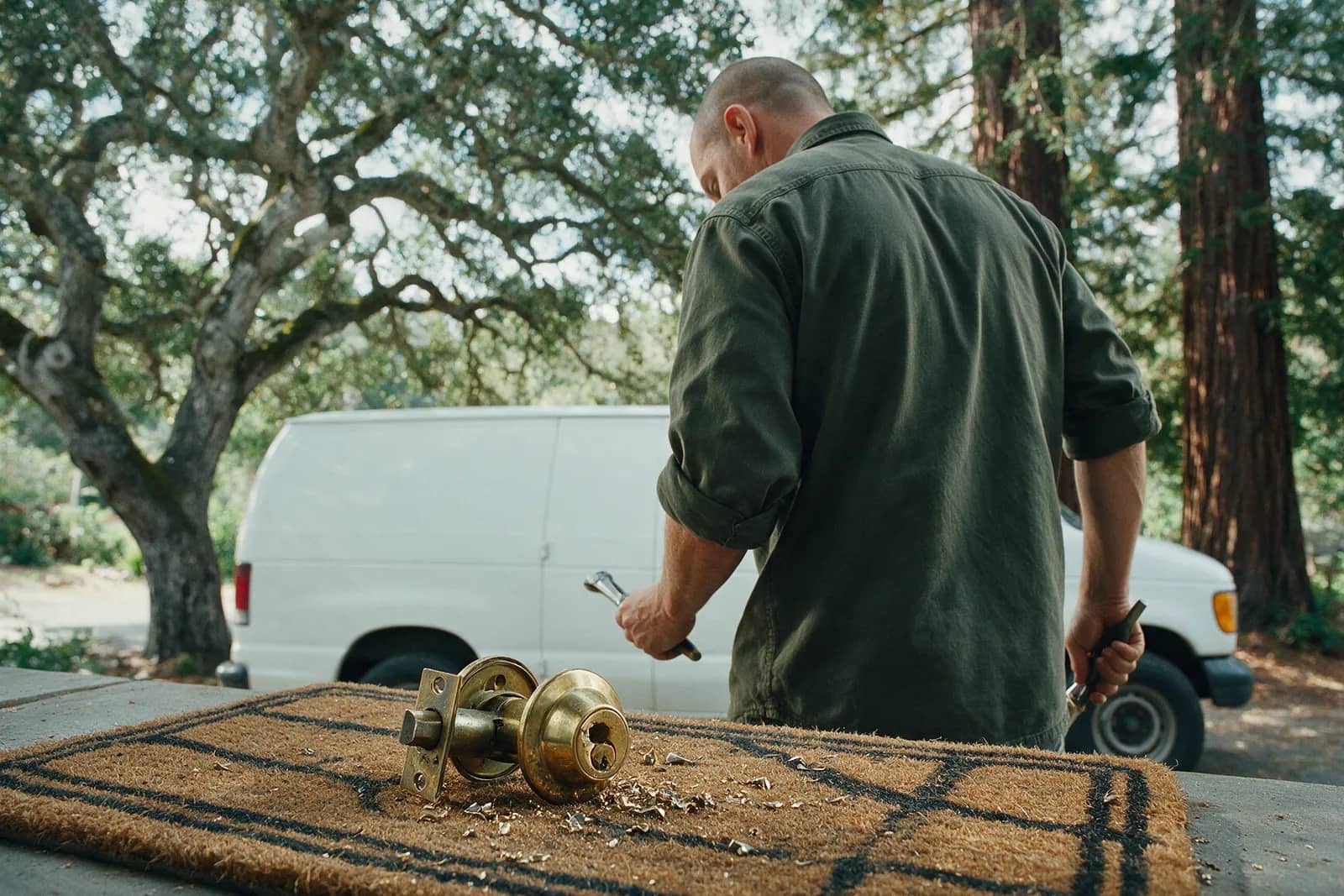
Campanile Lock & Key works to a promise called The Agreed-First Price, and it exists precisely for calls like these, where the distance and the stairs give a less careful company room to revise a number at the door. It is four things. The figure is agreed on the call and covers the visit, the labour and the parts. The technician name and a thirty-minute window arrive by text before the van leaves. The lock is opened without damage first, and drilling happens only after you agree to it, at the same figure. Card or tap is taken at the door, with an itemized receipt by email and a written line for a board or a landlord if you need one.
Two of those matter more on a hill than anywhere else. The arrival text, because twenty-six minutes is long enough that people start to wonder, and because a name and a window is better than a window alone. And the figure agreed in advance, because a driveway that turns out to be steeper than expected is the van driver problem, not a reason for the price of a rekey to move. Calls are answered 24/7, and the estimate you are given up there is built with the hill already in it.
Quick answers
Does a locksmith charge more for a house above Grizzly Peak Blvd?+
No. The $89 service call and every figure on the list are the same at any elevation in the city. The only additions anywhere are time-based: $35 between 8pm and midnight and $70 between midnight and 7am, and both are stated inside the total agreed on the call.
How long does it really take to reach a hillside address?+
About twenty-six minutes on average, against nineteen for the city as a whole. Road closures along the ridge, weekend traffic toward Tilden and heavy fog add to that, and when they apply it is said on the call rather than discovered at the top.
What if the gate code is with somebody who is not home?+
Say so when you call. The technician can be met at the gate when the arrival text comes, or the gate itself can be opened as part of the visit if you can show the property is yours. Either way it belongs in the plan before the van sets off, not at the curb.
Need it handled rather than read about?
(510) 392-6966More guides